With the usual disclaimer that it could all change tomorrow, there is hope that the adults in Washington can get beyond the "weasel" rhetoric and accusations of childishness to hammer out a deal that moderates on both sides can swallow as a necessary evil.
Poster of the three post-election prisoners killed in Kahrizak detention centre (see 0625 GMT)
1910 GMT: Reformist Watch. Arshama3's Blog has posted a useful critique of the comments of Mehdi Karroubi's advisor Mojtaba Vahedi (see 0815 and 1440 GMT), considering not only the approach to the 2012 Parliamentary elections but also "his refreshingly open comments" on "taboo topics" like the killing of dissidents in the 1980s.
1900 GMT: Ahmadinejad Watch. Over the last two days, we have been considering the claimed statement by Ayatollah Mesbah Yazdi, the President's one-time "spiritual mentor", backing Mahmoud Ahmadinejad but criticising the "deviant current" around him. Now Bibak, a site close to the Ayatollah, is denying the interview --- supposedly with Mehr --- ever took place.
1618 GMT: In the northern town of Jabal al-Zaweh, Idleb Province, the city was once the scene of 100,000 protesters, or more, every Friday. Today there are only 2,000 protesters in the streets. An Al Jazeera contact in the city explains:
“Since the military started their operations in the area and set up check points and started arresting people their presence has discouraged people from participating,” he said. “We are almost under siege and people find it difficult to get enough food on a daily basis.”
1553 GMT: Ahram News has posted their own liveblog from Tahrir Square. The protests across Egypt are once again on the rise, as frustration is growing at the Prime Minister and the Supreme Council for the Armed Forces. While protests have been limited in the months after the ouster of Mubarak, in recent weeks they have been larger in scale and more widespread.
In Egypt thousands of demonstrators descended on public squares around the country to offer a 'Friday of Final Warning' to the ruling military junta, amid fears that the revolution which toppled Hosni Mubarak is now being betrayed by conservative forces.
Rallies and hunger strikes were reported from Alexandria on the Mediterranean coast all the way down to Luxor in the south and Suez in the east, with the main focus once again on Cairo's Tahrir Square where a large sit-in is now over a week old and shows no sign of ending.
1615 GMT: Abdel Karim Rihawi of the Arab League of Human Rights has claimed that security forces killed two protesters and wounded in Deir Ez Zor in northeastern Syria on Thursday.
Rihawi said the mood was "tense and residents are observing a general strike". Videos indicate there have been stoppages in other cities in the country.
At least seven people were reportedly slain late Wednesday in Idlib Province in the northwest by security forces.
1515 GMT: The Libyan regime has halted all cooperation with Italian energy firm ENI, Libyan Prime Minister Al-Baghdadi Ali Al-Mahmoudi has said.
ENI, with a presence in Libya since the 1950s, is the biggest foreign oil company in the country, but it has suspended operations and establishing ties with the opposition.
Al-Mahmoudi said the regime was in talks with Russian, Chinese and American firms over new projects in Libya, but he did not give details except to say US firms could invest because Washington is not taking a direct role in the NATO bombing of Libya.
1459 GMT: Protesters march today in Al Khamis, Yemen:
1610 GMT: Political Prisoner Watch. More information about actress and filmmaker Pegah Ahangarani, who was reportedly detained earlier this week.
Ahangarani was supposed to cover this month's Women's Football World Cup in Germany for a blog on Deutsche Welle but was stopped from travelling a day before her depature. She then spent a few days with relatives, but there has been no contact with her since she returned home.
Ahangarani's latest documentary, shown on BBC Persian, is "Dehnamkiha". It narrates the life of Massoud Dehnamaki, one of the founders of the conservative activist group Ansar-e Hezbollah and now a prominent filmmaker. Ahangarani said the film had irritated officials and may have been the reason she was recently summoned by the Ministry of Intelligence for questioning.
1600 GMT: CyberWatch. An official of the Ministry of Culture and Islamic Guidance has said that the new social networking site Google Plus is the latest US spyware. It is supposedly replacing Facebook, which has suffered a large drop in users.
Iran authorities have announced the filtering of Google Plus, even though it is still in pilot stage.
UPDATE 1400 GMT: Afghanistan's Pajhwok News puts the death total at three, with 15 injured. One of the dead are clerics Maulvi Hikmatullah Hikmat, the head of Kandahar Ulema Council.
The attacker entered the mosque hosting a prayer gathering for the slain brother of President Karzai and detonated explosives strapped to his body.
Interior Ministry spokesman Ghulam Siqiq Sidiqi had said four people were killed.
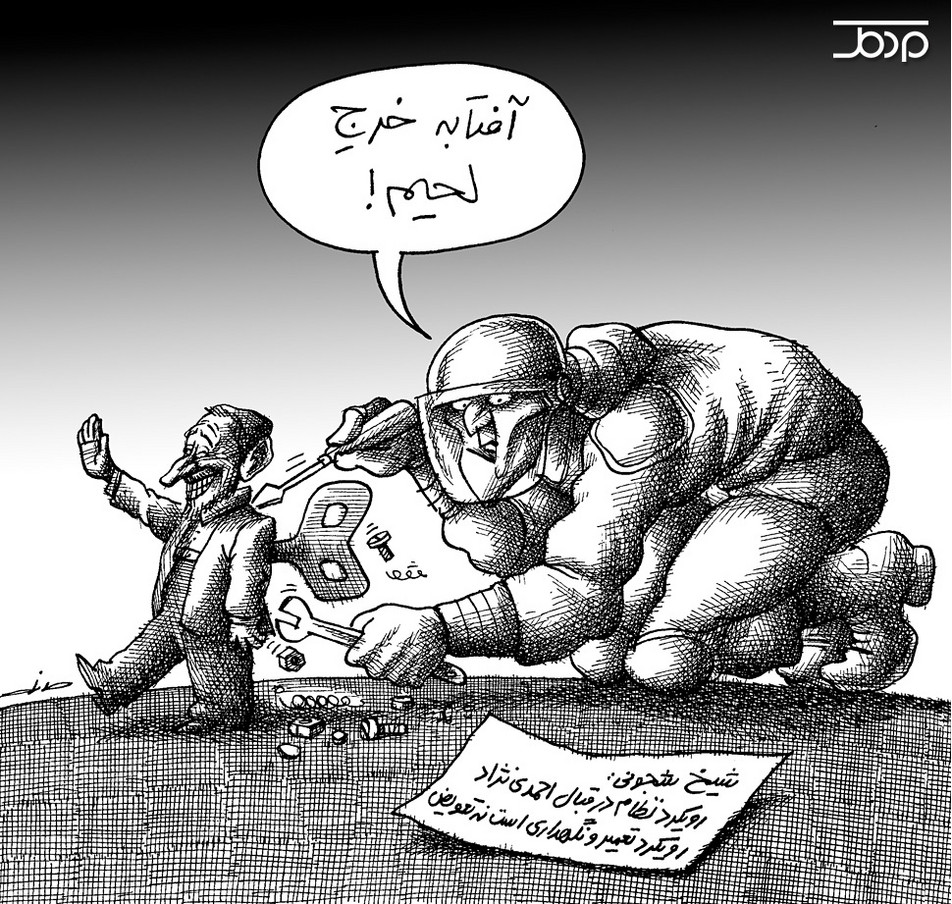
Ejecting Ahmadinejad from office before the end of his term would come at a high cost, and it’s only likely to happen if he makes himself absolutely intolerable for the Supreme Leader and the regime as a whole. In other words, it depends on a cost-benefit equation where the price of removing him is set against the price of continuing to put up with him.
Last month, as a flood of exuberant economic forecasts poured on Iran on the back of an unusually positive International Monetary Fund press release, one on-the-ground observer morosely invoked an old Iranian proverb: "My cheeks look rosy because I slap them" (Bah seeli sourat ra sorkh negah dashtan). To the members of Tehran's business and financial community, it appears the Iranian government has adhered to this saying, perking up its numbers to present the world with a peachy picture of its less-than-stellar economic performance.
No other city in the world has been the tragic target of as many serial terror attacks and bombings as Mumbai, which went through the agony in 1993, 2002, 2003, 2006, 2008 and now July 13, 2011. On Wednesday evening, three serial bomb blasts in the span of ten minutes ripped through three of the busiest hubs in the city — Zaveri Bazar, Opera House and Dadar — at rush hour, killing 17 people and injuring 131.
The first explosion was at 6.54pm at Zaveri Bazar, followed by another at Opera House a minute later. The third explosion was at 7.06pm outside Kabutarkhana, a few metres from the western side of Dadar railway station.
1650 GMT: A series of photos of the blast sites and victims has been posted (Warning: Graphic).
UPDATE 1640 GMT: The Home Ministry has revised the casualty figures to 20 dead and 113 injured.
UPDATE 1620 GMT: Important clarifications from the Mumbai Police Commissioner....
The three blasts were not from car bombs, as initial reports claimed in at least two cases, but from improvised explosive devices. The IED near the Opera House was "high-intensity"; the others in Zaveri Bazaar and Dadar West.
The three devices exploded between 6:50 and 7:04 p.m. local time.