




Sunday
Jun092013
Syria Today: Opposition Repeats --- No Participation in International "Peace" Conference
 Sunday, June 9, 2013 at 13:15 | Scott Lucas in EA Live, EA Middle East and Turkey, Middle East and Iran
  Sunday, June 9, 2013 at 13:15 | Scott Lucas in EA Live, EA Middle East and Turkey, Middle East and Iran Sunday, June 9, 2013 at 7:54 | Scott Lucas in EA Live, EA Middle East and Turkey, Middle East and Iran
 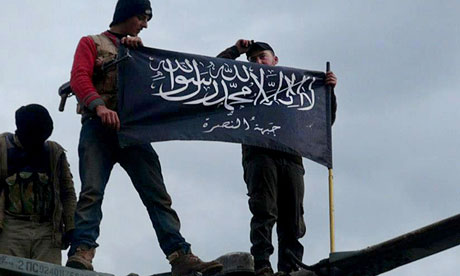 Activists with Jabhat al-Nusra FlagWriting for Al Jazeera English, Basma Atassi, claims that the head of Al Qa'eda, Ayman al-Zawahari, has intervened in a dispute between the Syrian insurgency Jabhat al-Nusra and the Islamic State of Iraq with a letter to the leaders of the two groups.
The clash arose in April when the head of the ISI, Abu Bakr al-Baghdadi, tried to claim oversight of Jabhat al-Nusra in a message. A senior JAN commander, Abu Muhammad al-Joulani, responded by asserting the insurgents' autonomy in Syria.
Media coverage incorrectly claimed that the ISI and JAN had "merged", as well as emphasising al-Joulani's reference to al-Zawahari as a "pledge of allegiance".
Saturday, June 8, 2013 at 6:23 | Joanna Paraszczuk in EA Live, EA Middle East and Turkey, Middle East and Iran
Al Jazeera English reports from Arsal in Lebanon, where some of those wounded during the three-week battle for Qusayr have been taken:
Friday, June 7, 2013 at 6:44 | Scott Lucas in EA Live, EA Middle East and Turkey, Middle East and Iran Aleppo, Austria, Ayman Kareem, Golan Heights, Israel, Kafranbel, Syria Thursday, June 6, 2013 at 7:34 | Scott Lucas in EA Live, EA Middle East and Turkey, Middle East and Iran 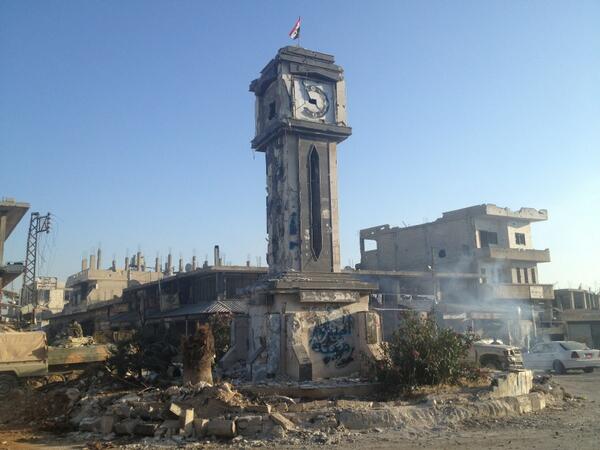 Qusayr After the Battle Zawahiri Calls To Prevent "Pro-US Regime" In Syria
An audio recording purportedly from Ayman al-Zawahiri, the leader of al-Qaeda, calls on jihadi groups in Syria to prevent the establishment of a pro-US regime in the country.
In the message, published on the internet on Thursday, urges the "Lions of Islam in ash-Sham [the Levant] to gather and unite" above sectarian issues, saying that "America and its agents" want you to shed your blood… to bring down the criminal Baathist regime and then to set up a regime loyal to them that will guarantee Israel's security".
The message goes on to say that jihad in Syria aims to establish an Islamic caliphate in the country, and then condemns Iran for desiring "Safavid expansion". The Mujahadeen of as-Sham have "exposed the ugly face of Iran…and its heinous crimes", al-Zawahiri says.
Footage from Al-Mayadeen TV of the regime capture of Qusayr
Qusayr did not resolve the Syrian conflict. It only highlighted that resolution is distant.
The regime is unlikely to alter this with victory in one town, achieved only with substantial help from Hezbollah. Whether the insurgency and the "West" can do so is the more intriguing scenario.
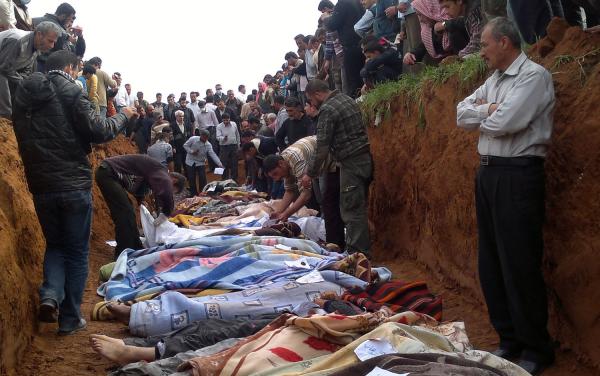 Bodies in Taftanaz, April 2012Government forces and affiliated militia have committed
murder, torture, rape, forcible displacement, enforced disappearance and other inhumane acts. Many of these crimes were perpetrated as part of widespread or systematic attacks against
civilian populations and constitute crimes against humanity. War crimes and gross violations of international human rights law –-- including summary execution, arbitrary arrest and detention, unlawful attack, attacking protected objects, and pillaging and destruction of property --- have also been committed. The tragedy of Syria’s 4.25 million internally displaced persons is compounded by recent incidents of IDPs being targeted and forcibly displaced.
Bodies in Taftanaz, April 2012Government forces and affiliated militia have committed
murder, torture, rape, forcible displacement, enforced disappearance and other inhumane acts. Many of these crimes were perpetrated as part of widespread or systematic attacks against
civilian populations and constitute crimes against humanity. War crimes and gross violations of international human rights law –-- including summary execution, arbitrary arrest and detention, unlawful attack, attacking protected objects, and pillaging and destruction of property --- have also been committed. The tragedy of Syria’s 4.25 million internally displaced persons is compounded by recent incidents of IDPs being targeted and forcibly displaced.
Tuesday, June 4, 2013 at 5:45 | Scott Lucas in EA Live, EA Middle East and Turkey, Middle East and Iran Residents digging through rubble in Kafar Hamra section of Aleppo after Sunday's missile strike
US Cautious About Claims of Regime Use of Chemical Weapons
The White House has been cautious about a French finding that the regime has used chemical weapons.
"We need more information" about claims of such use, spokesman Jay Carney said.
Carney said there is a need to gather more evidence to pin down when chemical weapons were used, who employed them, and what the chain of custody was: "[We must] establish a body of information that can be presented and reviewed, and upon which policy decisions can be made."
Carney had no timetable for when the review might be completed, although he said, "I can assure you that we are working very diligently as an administration with our allies and the Syrian opposition on this matter."
France, Jay Carney, Syria, Wael al-Halki James Miller writes to EA readers:
It has been my honor to write for EA Worldview for the last 2 1/2 years. Now, however, I am leaving EA to pursue new projects.
This is a bittersweet moment for me. I am excited about the new directions in which my life is headed, and I anticipate wonderful things for EA; at the same time I will miss a place that has been my "home".
One of the opportunities I am pursuing is The Public Eye Journalism Project in conjunction with Professor Matt Sienkiewicz of Boston College. Still in beta, PEJ is dedicated to using open-sources to investigate international events of legal, political and historical importance.
Our first case is the examination of the double bombing on January 15th that left 80 students dead at Aleppo University in Syria.
I wish Scott Lucas, the writers and staff at EA, and all of the readers --- many of whom I have come to know well --- all the best.
Monday, June 3, 2013 at 12:55 | Scott Lucas in EA Live, EA Middle East and Turkey, Middle East and Iran See also Middle East Today: Turkey --- Mass Protests and Clashes Move Beyond Istanbul
Sunday's Syria Today: The Civilians Trapped in Qusayr
Report: US Discussing Placement of Patriot Missiles in Jordan
A senior Pentagon official has said that the US and Jordan are discussing the possibility of sending American Patriot anti-aircraft missile batteries to the Kingdom, amid the Syrian conflict and the training and arming of insurgents from a base in Jordan.
The official emphasised that an agreement over the deployment has not been reached. However, he said the missile batteries could be flown to Jordan within days and used initially as part of a multinational military exercise in June.
Aleppo, Hezbollah, Jordan, Kasem Alzein, Lebanon, Louay al-Mokdad, Syria