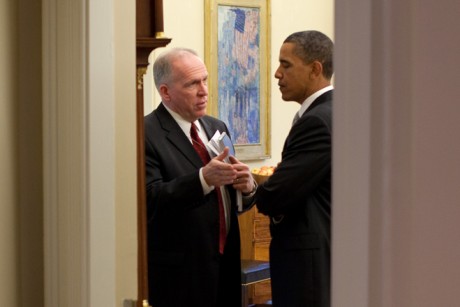
John Brennan & Barack Obama (Pete Souza/White House)In his windowless White House office, presidential counterterrorism adviser John O. Brennan is compiling the rules for a war the Obama administration believes will far outlast its own time in office, whether that is just a few more months or four more years.
The “playbook,” as Brennan calls it, will lay out the administration’s evolving procedures for the targeted killings that have come to define its fight against al-Qaeda and its affiliates. It will cover the selection and approval of targets from the "disposition matrix", the designation of who should pull the trigger when a killing is warranted, and the legal authorities the administration thinks sanction its actions in Pakistan, Yemen, Somalia and beyond.
Human Rights Watch has published a 50-page report, "Death of a Dictator: Bloody Vengeance in Sirte", which charges Misurata-based militias with the apparent execution of dozens of detainees, including former Libyan leader Muammar Qaddafi, in Sirte in October 2011.
HRW claims the militias captured and disarmed members of the Qaddafi convoy. They brutally beat the men and executed at least 66 of them at the nearby Mahari Hotel. The organisation alleges that militias took Qaddafi’s wounded son Mutassim from Sirte to Misrata and killed him there.
Among the new evidence is a mobile phone video, filmed by opposition militia members, that shows the abuse of captured convoy members. At least 17 of the detainees in the video were later executed at the Mahari Hotel.
Zero-sum logic ignores the fact that, like it or not, we are all in this together. Each act of political violence that occurs in Israel and Palestine these days is deeply intertwined with the failure to make peace and the cycle of violence that has arisen in its stead. Torture on either side of the Gaza border will never enhance security on the other.
Regime soldiers held by insurgents in Deir Ez Zor Province
Armed opposition groups have subjected detainees to ill-treatment and torture and committed extrajudicial or summary executions in Aleppo, Latakia, and Idlib, Human Rights Watch said today following a visit to Aleppo governorate. Torture and extrajudicial or summary executions of detainees in the context of an armed conflict are war crimes, and may constitute crimes against humanity if they are widespread and systematic.
Opposition leaders told Human Rights Watch that they will respect human rights and that they have taken measures to curb the abuses, but Human Rights Watch expressed serious concern about statements by some opposition leaders indicating that they tolerate, or even condone, extrajudicial and summary executions. When confronted with evidence of extrajudicial executions, three opposition leaders told Human Rights Watch that those who killed deserved to be killed, and that only the worst criminals were being executed.
A funeral procession in Darayya in August, days before the deadly regime attacks
Two weeks on, Darayya still stinks of death. A poor Sunni suburb south of Damascus, it had been well known for furniture-making, and for its peaceful resistance before the conflict. Now it is a ghost town of shattered glass and broken graveyard walls, bombed vegetable shops and decapitated blocks of flats. Rank rubbish is piled on corners, uncollected. There is the unmistakable smell of rotting corpses that have not yet been removed from houses. A lone bicyclist makes his way awkwardly through the rubble and debris.
Whilst much of the Bahrain regime's ongoing repression is relatively free from international scrutiny, Thursday's sentencing of leading human rights activist Nabeel Rajab to three years --- on three separate charges of instigating and participating in "illegal gatherings" --- will not go unnoticed. In recent weeks, many international NGOs and even 19 members of the US Congress have called for the immediate release from detention of Rajab, who is also serving a three-month sentence for his messages on Twitter.
So why would the Bahraini regime, which has been desperately seeking to convince the international community that it is committed to reform, hand down the lengthy sentence, an act bound to create questions about its commitment?
1823 GMT: Bahrain. Gulf News Daily reports that three of the seven men accused of attacking security forces with Molotov cocktails in Abu Qawa in February --- seriously injuring one policeman --- were in prison at the time of the attack, according to their defence lawyer. The paper quotes lawyer Shazlan Khamis as having told the High Criminal Court yesterday:
My three clients were convicted of participating in an illegal gathering and were in jail at the time of the attack, the investigating officer had initially claimed they were on the run, but that's not true because they were jailed.
The investigating officer on the case says that "secret sources" revealed to him the identity of all seven men, adding that "they were already in jail for another case when we questioned them."
1815 GMT:Bahrain. A final verdict was expected today in the case of the 28 Bahraini medical professionals facing misdemeanour charges (see 0615 entry). However, in court the judge postponed the case until September 4th, reports Human Rights First, adding that the delay is so the judge can "consider allegations of torture against the medics during their detention last year". Commenting on the decision, Brian Dooley of Human Rights First said:
“Justice delayed is justice denied even longer for these medics who should not be on trial in the first place. Today’s delay shows the dictatorship is refusing to listen to international calls for reform by continuing with these politically-motivated trials. The medics should all have been acquitted today and investigations opened into who tortured them in custody.”
The NGO also quotes the reaction of neurosurgeon Nabeel Hameed, one of the 28:
Our suffering continues and our future is unclear. All the medics are disappointed as it means our lives continue in suspended animation.
Former detainees and defectors have identified the locations, agencies responsible, torture methods used, and, in many cases, the commanders in charge of 27 detention facilities run by Syrian intelligence agencies....The systematic patterns of ill-treatment and torture that Human Rights Watch documented clearly point to a state policy of torture and ill-treatment and therefore constitute a crime against humanity.
If you wish to embed this feature on your website, please click here and follow the instructions.
2125 GMT:Syria. In an interview on Iranian state television, President Assad has drawn a line against an outside solution for the Syrian political crisis: "We will not accept any non-Syrian, non-national model, whether it comes from big countries or friendly countries. No one knows how to solve Syria's problems as well as we do."
Assad also offered no sign of relenting in the military campaign against opposition:
The responsibility of the Syrian government is to protect all of our residents. You have a responsibility to eliminate terrorists in any corner of the country. When you eliminate a terrorist, it's possible that you are saving the lives of tens, hundreds, or even thousands.
Iranian journalists are amongst those who have become victims of human rights abuse, as a result of their work in promoting human rights in Iran, and have been oppressed by Iran's security agents and judiciary. These journalists, with their writing and ideas for peace, have become targets for human rights abusers.
The increasing pressure on journalists by the security agents follows no laws and rules and this has forced many of them to leave their motherland, against their will, to seek refuge in neighboring countries and to ask for asylum from the UN High Commission for Refugees. Many are currently incarcerated, and those seeking asylum face heavy sentences if they return to Iran. Iranian security agents have threatened them on numerous occasions and caused them anxiety.








 Saturday, October 27, 2012 at 7:12
 John Brennan & Barack Obama (Pete Souza/White House)In his windowless White House office, presidential counterterrorism adviser John O. Brennan is compiling the rules for a war the Obama administration believes will far outlast its own time in office, whether that is just a few more months or four more years.
