1700 GMT: News has just arrived that Kamal Ghanzouri has been appointed as the new prime minister of Egypt by SCAF. Ghanzouri is a former prime minister, who served under ex-President Hosni Mubarak from 1996 to 1999 and has a PhD from the University of Michigan.
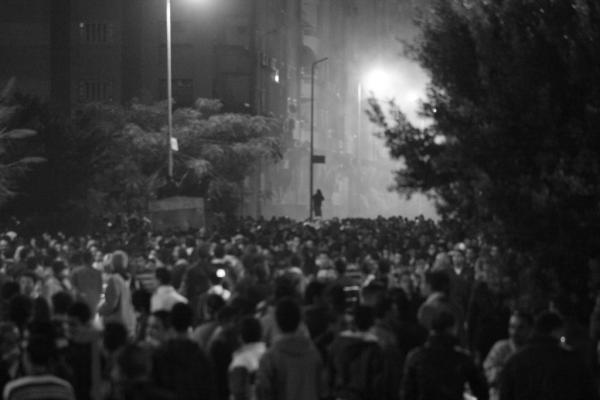
2108 GMT: We still have an overhead feed from Tahrir Square at the top of this entry, but this live video feed appears to be from Mohamed Mahmoud street in Cairo:
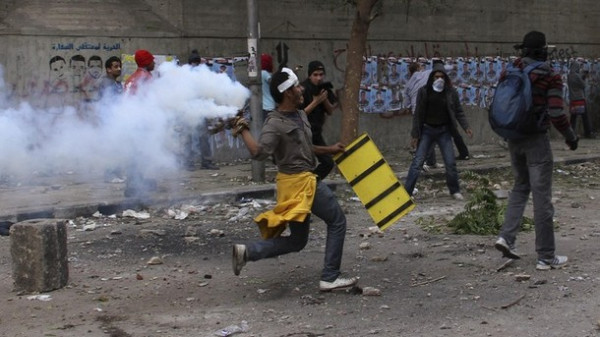
2030 GMT: The live images from Alexandria are dramatic. So much tear gas was fired at a car that it lit on fire. At times, the gunfire is almost constant, though it is hard to tell whether the gunshots are tear gas cannisters, rubber-coated steel bullets, or live ammunition.
Protesters are now walking directly into the line of fire of the police.
Activist montage of the march today in Sitra in Bahrain for 16-year-old Ali Alsatrawi, killed last week by a police jeep, and the attack on it by security forces
2134 GMT: The voice of the opposition that is not going away in Tahrir Square:
The President has stepped down, key advisors have stepped down, and the cabinet has offered its resignation, but the people of Egypt have yet to feel the reform that the process has promised. With elections only a week away, the people in the streets are giving a clear mandate: they want the resignation of SCAF, free and fair elections, and the freedom of expression and representation that the military is fighting against until the last minutes of this transitional government.
Egyptian police beat protesters --- note the man knocked unconscious by a baton --- and drag them away, including one by the hair, just off Tahrir Square
Rachid Ghannounchi, leader of Tunisia's EnnadhaCivic Islamism is linked with the novelty of the context, the Arab Spring, and the new dynamic of legalised Islamism as in Egypt and Tunisia. Civic Islamism displays features of impressive organisation for the contest of power, coupled with an aptitude to penetrate secular civil society through coalition-building with non-Islamists.
Only through inclusion, competition, participation and the tests of "power", will this force learn to moderate its politics, gradually learning to take its place amongst the progenitors of civic politics in the Arab spring states.
The atmosphere in Egypt is tense. There is concern, nine months after the fall of Hosni Mubarak, about the hard task of building a nation, as Observers warn, "Two weeks before parliamentary elections billed as a first big step toward democracy, there are new signs that the generals still ruling Egypt are trying to steer the transition to preserve their vast political and economic power." The military rulers have imposed punishment on 11,697 civilians since February. Prominent activists like Alaa Abd-El Fattah are detained.
In the midst of this is an incident on 9 October, when 28 people were killed after a march, mainly of Coptic Christians, was attacked in the Maspero section of Cairo. The regime blamed protesters for causing trouble and assaulting the military. Activists say the deaths were due to the security forces --- this is their account of that evening:
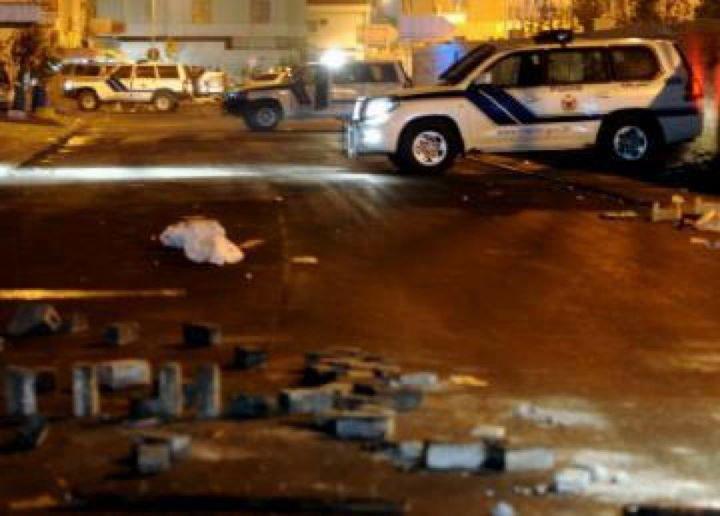
Police clash with protesters after breaking up a march in Nabeeh Saleh in Bahrain on Friday night
1955 GMT:One protester was killed and 12 others injured on Sunday when Egyptian security forces clashed with protesters staging a sit-in for the sixth day against the expansion of the MAPCO-Agrium fertilizer plant in Damietta.
Confrontations began on Saturday night and continued into early Sunday morning, with security forces using tear gas bombs to disperse protesters.
0150 GMT: The Bahraini Ministry of Interior is now trying to explain how its policemen were not responsible for the attack on the house and car of the head of the Al-Wefaq opposition party, Sheikh Ali Salman, blaming protesters while shifting attention from authorities:. Here's the lengthy statement in full from the Ministry of Interior's website:
The General Director of Northern Governorate Police has announced that at around 10:55 PM on Thursday around 60 individuals went into illegal procession in Bilad Al Qadeem with the aim to block roads and hinder traffic flow. They were also involved in vandalism, rioting and hurling Molotov cocktails and stones at policemen. This led to the interference of police forces to disperse them and reopen the roads by shooting tear gas and sound shoots.
In regard of what was circulated by some individuals through social media websites claiming that the house and car of the General Secretary of Al Wefaq National Islamic Society were damaged by policemen, the General Director explained that vandals were 50 meters away from the house and there was a distance of around 50 meters between vandals and policemen, hence they were around 100 meters away from the house. Policemen used teargas and sound shoots and both are hurled by hand, so it is difficult for them to reach to the house and the car that was next to it. The shell...that was found inside the car is a [shell] that is hurled by the hand as it is shown in the image.
He added that the concerned team moved to the scene, while no complaint was reported by those affected by the incident and that explains that those who created the damages bear the responsibility of what they did.








 Thursday, November 24, 2011 at 6:15 |