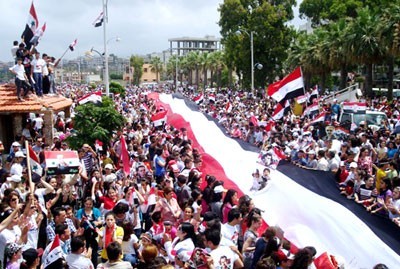





People rally after evening prayers in the Midan section of Damascus --- note the masks and scarves worn by many to disguise identities
1855 GMT: This video, claiming to have been taken today in Sitra, Bahrain, shows a crowd of police arresting an unarmed man.
1841 GMT: Turkey has delivered the first shipment of oil to the Eastern Libyan city of Benghazi, part of a $10 million oil deal. This shipment will supply needed oil to the Libyan rebels, who have been unwilling to operate their oil infrastructure for fear of Gaddafi's forces targeting the resources.
In the south, tribesmen on Monday said they routed militants from parts of the capital of the flashpoint Abyan province. Zinjibar lies east of a key shipping channel where some 3 million barrels of oil pass daily, and is one of several areas in Abyan seized by militants in recent months.
The tribes began backing a military operation to recapture Zinjibar in recent weeks, after accusing the army of being ineffective.
A tribal source said fierce clashes on Monday sent many militants fleeing north to Lawdar, where they were repelled again. Six militants were wounded and four others captured, he said.
2000 GMT: Activists claims Syrian troops have assaulted the village of Sarjeh in Idleb Province in the northwestern Syria. Troops backed by tanks reportedly entered the village, arresting residents as electricity and water supplies were cut off.
Activists also reported reinforcements entering Homs and detentions in the capital of Damascus, especially the Rukn ad-Deen and Qaboun neighbourhoods where protests have escalated.
1950 GMT: A march in Nuwaidrat in Bahrain in support of opposition activist Ibrahim Sharif, who has been sentenced to five years in prison.
2025 GMT: Syria state news agency SANA is highlighting pro-regime rallies throughout the country today, including marches in Damascus, Baniyas, "stressing rejection of all forms of foreign interference in Syria's affairs".
The demonstrators unfurled large Syrian flags, sang the national anthem, and chanted in support of President Assad's reform programme.
2010 GMT: Footage from Morocco's largest city Casablanca of today's pro-reform demonstration:
A scene as night falls in Tahrir Square (Photo: Isabel Esterman)
If Tahrir is a microcosm of modern-day Egypt with all of its issues --- and it managed to get there in a week --- then being there for the next few days is crucial to understand what might happen in the next few years and how to prevent it. The lessons that we will learn from being there now, about our problems and the proposed solutions to solve them, are invaluable for a nation that is seeking a new beginning like ours, not one that we created from scratch like Tahrir [has been]. All of those people with ready-made solutions should go and try them out there before proposing it nation-wide. All of those people from outside who know how to best solve our problems should come and help us solve them, because as a nation we will also need this help from Egyptians from abroad, whether we like it or not. Basically if you are interested in figuring out what the problems facing our society and the best way to solve them, Tahrir is where you should be heading to right now.
And you must stay with us, and help us in every way you can if you choose that responsibility. We no longer want tourists who want to have fun and give advice from afar, we want people who love this country so much that they are willing to get their hands dirty, even if it means standing at a security checkpoint for two hours a day, and spending the rest with your friends there. Let’s go, and try, and fail and learn with us there, because that’s better done in Tahrir than in Egypt. It’s really simple: If everything is hazy, and you want to know what’s going to happen next in the country, Tahrir, right now, even if this sit-in lasts for one more day, is the place to be.
1618 GMT: In the northern town of Jabal al-Zaweh, Idleb Province, the city was once the scene of 100,000 protesters, or more, every Friday. Today there are only 2,000 protesters in the streets. An Al Jazeera contact in the city explains:
“Since the military started their operations in the area and set up check points and started arresting people their presence has discouraged people from participating,” he said. “We are almost under siege and people find it difficult to get enough food on a daily basis.”
1553 GMT: Ahram News has posted their own liveblog from Tahrir Square. The protests across Egypt are once again on the rise, as frustration is growing at the Prime Minister and the Supreme Council for the Armed Forces. While protests have been limited in the months after the ouster of Mubarak, in recent weeks they have been larger in scale and more widespread.
In Egypt thousands of demonstrators descended on public squares around the country to offer a 'Friday of Final Warning' to the ruling military junta, amid fears that the revolution which toppled Hosni Mubarak is now being betrayed by conservative forces.
Rallies and hunger strikes were reported from Alexandria on the Mediterranean coast all the way down to Luxor in the south and Suez in the east, with the main focus once again on Cairo's Tahrir Square where a large sit-in is now over a week old and shows no sign of ending.
1645 GMT: Thanks to James Miller for taking the LiveBlog through the afternoon.
Video testifies to a series of protests across Yemen today, calling for a transitional government. Claimed footage of a march in Taiz attacked by security forces:
2015 GMT: Claimed footage of protest tonight in Homs in Syria:
1915 GMT: In Morocco, thousands of people have marched in Casablanca and the capital Rabat, demanding political change and greater social justice.
In Casablanca, more than 8000 people, chanted slogans such as "Less corruption and a fair distribution of wealth", "Sovereignty to the people", and "We want more equality".
Protests tonight in the Midan section of the Syrian capital Damascus
2050 GMT: Human Rights Watch says defectors from Syria’s security forces have described receiving orders from their superiors to fire live rounds at protesters to disperse them.
HRW issued a statement based on interviews with eight soldiers and four members of secret security agencies. The interviewees said they had participated across the country in the crackdown, including in Daraa, Izraa, Baniyas, Homs, Jisr al-Shughour, Aleppo, and Damascus. They said they had participated in and witnessed the shooting and wounding of dozens of protesters and the arbitrary arrests and detentions of hundreds of civilians.
All the interviewees say their superiors told them that they were fighting infiltrators, "salafists" (hard-line Sunni adherents), and terrorists, but they were surprised to encounter unarmed protesters instead. They said they were ordered to fire on the civilians, including children, in a number of instances.
The defectors also reported that those who refused orders to shoot on protesters ran the risk of being shot themselves. One of them said they witnessed a military officer shoot and kill two soldiers in Daraa for rejecting orders.