




1930 GMT:Even Government Sources Admit Baniyas is Different.
The Baniyas massacre on Syria's coast may be a singular event that stands out as being dramatically different than all the other massacres. For starters, the scale of the massacre is at least among the worst of all of Syria's massacres, though some reports suggest that it may be magnitudes worse than any event that has taken place since the start of this crisis. Also, this incident had a clearly sectarian nature to it that is not disputed - Alawite militias loyal to President Assad targeted Sunnis, many of them children, and killed them en masse. In a thorough, nuanced, and eloquent description of the massacre, the New York Times' Anne Barnard and Hania Mourtada point out that the Assad government typically blames civilian deaths on "terrorists" even when their own forces and loyalists are implicated. This time, however, even the government admitted that its people were responsible for a mass killing, though they tell a different tale than Baniyas's residents:
Multiple video images that residents said they had recorded in Bayda and Ras al-Nabeh — of small children lying where they died, some embracing one another or their parents — were so searing that even some government supporters rejected Syrian television’s official version of events, that the army had “crushed a number of terrorists.”
One prominent pro-government writer, Bassam al-Qadi, took the unusual, risky step of publicly blaming loyalist gunmen for the killings and accusing the government of “turning a blind eye to criminals and murderers in the name of ‘defending the homeland.’ “
The article chronicles some of the evidence and eyewitness reports. It also argues that there were those who were trying to break with the sectarian nature of the killings even while the violence was ongoing. In the end, however, it's a must-read article on a story that has been under-reported.
1625 GMT:Limited Use of Chemical Weapons Part of Assad's Strategy? Pundits are arguing for or against foreign intervention in Syria, and much of their analysis of this week's chemical weapons claims are shaped by that goal. Chemical weapons analysts have focused on the available evidence, and have offered their criticism or support of the claims that Assad used of chemical weapons in that light. Today, however, two analysts focus on the wider strategic situation in Syria, and how chemical weapons claims fit into that picture.
The Obama Administration has come to the point where it either has to withdraw from the effort to provide weapons --- in which, it faces the prospect of insurgents, some of whom it does not like, getting the arms elsewhere and thus being beyond US "influence" --- or it accepts that the weapons will not always remain in the hands of "moderate" factions.
The US official says --- although the Journal does not realise this --- that the Obama Administration has chosen the latter scenario.
It is this, not the inaccurate hook-line of "Islamists tied to Al Qa'eda", which is the real story of US intervention in the Syrian conflict.
1959 GMT:More Rebel Firepower in Aleppo. To drive home the point that the rebels of the Liwaa al Tawid Brigade are deploying a significant amount of firepower, a reader shares a video of either a T-62 or T-72 tank (hard to distinguish between the two from this angle) used against the regime's base in the area of the Jandalla Roundabout, near the Aleppo Central Prison (see update 1932).
It appears that the scope of this offensive is quite large, spanning a stretch or bases and industrial buildings that stretch between the Jandalla Roundabout and the Central Prison to the north. This suggests that this operation was carefully planned, especially since so many heavy vehicles and field guns have been deployed to the area at the same time.
It's unclear if the rebels captured the prison. Still no sign of regime airforce in any of the videos we've seen, however.
Commander Salim IdrissUltimately, even if the SMC only serves as a mechanism for greater cooperation and coordination, it is a significant development in that it has united the efforts of rebel commanders across Syria. It is the first attempt at unity that incorporates important commanders from all Syrian provinces and has enough legitimacy on the ground to even begin the process of building a structure capable of providing a national-level chain of command.
Syria’s state security apparatus will collapse as the Assad regime finishes its transformation into a militia-like entity. The Supreme Military Command is currently the only organization that could serve to fill the security vacuum left by this transformation. As the Syrian opposition begins to build a transitional government, the SMC could create a framework for rebuilding Syria’s security and governing institutions if properly supported. The SMC’s ability to act as a basis for a national defense institution will be an important component in filling the power vacuum left by Assad’s fall and will aid in a secure and stable Syria.
There remain a number of critical obstacles ahead for the SMC.
Map of Rebel and Regime Territoyr in Daraa by stApexf.
Today, insurgents from the Dawn of Islam Brigade captured several key checkpoints across a town named Dael (often written Da'el) in Daraa Province. There are reports that the fighters have control of the entire town.
Dael's fall is significant. It may be the defining example of how the international effort to give military assistance to the rebels, led by Saudi Arabia and the US, is rapidly changing the face of the war.
Control of Daraa Province gives the rebels access to Syria's border with Jordan, from where outside forces are providing military asssistance.
Dael is strategically located for that obejctive. Its capture would both help insulate rebel territory from attack, and serve as a base from which to attack the provincial capital, Daraa.
For these reasons, Dael may have been specifically targeted by what may be the most important insurgent organization in southern Syria, one with ties to rebel commander Salim Idriss.
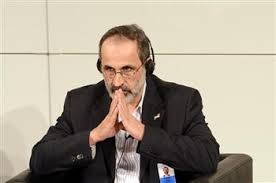
Moaz al-KhatibThe reasons for the in-fighting and divisions may be unclear --- the supposed explanations are more extensions-by-rumour of the in-fighting, rather than measured analysis --- but the effect is more than evident.
Even as key players in the international community have been moving aggressively, albeit behind the scenes, to consolidate support for a political and military challenge to the Assad regime, the stark question --- which was always there, but which elevated itself on Sunday --- remains:
General Salim Idriss, head of the insurgent Supreme Military Council, addresses Syrian expatriates, 24 February 2013
One of the themes in our daily coverage of Syria is the state of the insurgency, from the ideology and organisation of different factions to the supply of weapons to the efforts to declare an umbrella leadership such as the "Free Syrian Army".
Last week, Aron Lund brought these issues into stark relief with a post on Syria Comment questioning if one could even speak of an FSA. Days later, Koert Debeuf replied on the website with a vigorous defence of a leading group directing the
EA's James Miller comments:
Lund made some important points in his initial article. To criticise it by saying that it was an oversimplification would be unfair. After all, nothing is more complex than the "Free Syrian Army", and Lund has produced an impressively concise summary.
Debeuf, however, makes a more important point. The "Free Syrian Army" has never had any meaning more than it does todayinsurgency.
The opening and closing sections of the Lund and Debeuf articles....
Kurdish and Arab militias waged a bitter battle for three months in the northern city of Ras Al Ayn, in Hassakeh province. Now, they’ve reached a truce that has managed to last into a third week, marking an early success for a nascent group of peacekeepers led by famed Christian dissident Michel Kilo....
The months of fighting in Ras Al Ain killed nearly 300 people. It took a diverse group of men and women, Kurds and Arabs, Alawites, Sunnis, Christians, tribal leaders and urbanites to broker Feb. 17’s tenuous peace.