



Iran Election Guide

Donate to EAWV


Or, click to learn more

Search

Entries in sanctions (28)

Friday
Mar292013

Iran Special: Sanctions, "Analysis", and the Never-Ending Circle of Propaganda --- From NIAC to Neo-Cons

Most of what passes in the US press and circles of influence as "analysis" of Iran is actually political posturing, trying to put forward self-interested opinion as the Truth.

This is a story of how that "analysis", caught up in a false "either-or" of Iran --- it is either menacing, or it is oppressed by the "West"; it is either pursuing a Bomb, or it has no such intention; there will be regime change or a dominant regime which will never be changed --- leads us,  again and again, to political dead-ends.

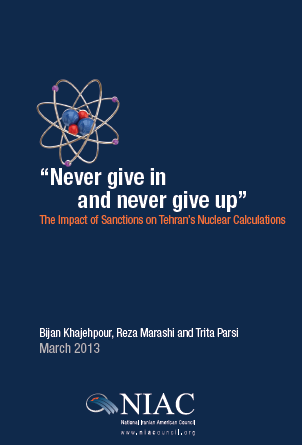
This is the story of the 32-page report that Trita Parsi and Reza Marashi of the National Iranian American Council, working with economist Bijan Khajehpour, put out this week, "Never Give Up, Never Give In".

Click to read more ...

Saturday
Jan192013

Iran Feature: The Week in Civil Society --- A Health Care Crisis, Economic Rumblings, and Election Grumblings (Arseh Sevom)

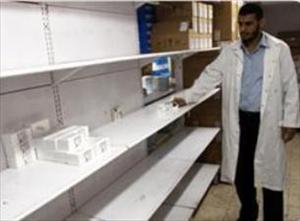
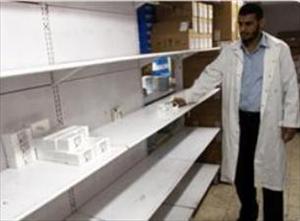
Despite efforts to keep life-saving medicine from falling victim to sanctions, there is a shortage in Iran. “Free” elections is a hot topic while the squeeze on purchasing power worries a Revolutionary Guard Commander. Musicians find themselves behind bars and Yahoo! rolls out secure email.

Click to read more ...

Saturday
Dec082012

Iran Snap Analysis: A Regime Still Worried About the Green Movement? (Yes.)

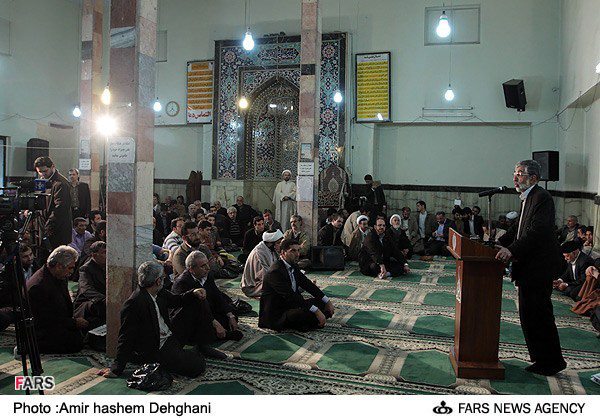
Gholam Ali Haddad Adel, a member of the Supreme Leader's inner circle, addresses an audience before the March 2012 Parliamentary elections


“The impressive participation of 85% of the people in the 2009 election was a subject of pride for us, but unfortunately some embittered the sweetness of the election the day after and labelled the regime [guilty] of fraud....The damage by the seditionists was no less than the damage Saddam did in the 8-year war [between Iran and Iraq in the 1980s.”

Click to read more ...

Thursday
Nov222012

The Latest from Iran (22 November): Ahmadinejad Benefits from Tehran's Problems Abroad

See also Iran Feature: The Week in Civil Society --- A Health Crisis, A Hunger Strike, and Keeping Women at Home
The Latest from Iran (21 November): The Economy? "All Is Well"


1740 GMT: Political Prisoner Watch. Tehran Prosecutor General Abbas Jafari Doulatabi has stopped all in-person visits in the women’s section of Evin Prison, according to opposition websites.

Kalemeh wrote that female inmates who had children were allowed to meet with them in person on Wednesday, but yesterday the prisoners were told that these visits are cancelled until further notice.

Prison authorities have informed detainees that the decision has been handed down from the prosecutor’s office and prison officials have no authority to alter it.

Up to nine women political prisoners recently went on hunger strike over their treatment, including denial of visits, and seven of them signed a statement of condolence to the family of Sattar Beheshti, a blogger killed earlier this month during interrogation in prison. The women have also expressed sympathy with detained lawyer Nasrin Sotoudeh, who is in the fifth week of her hunger strike.

Click to read more ...

Tuesday
Nov132012

Iran Opinion: The Crisis in Medical Care --- It's Not Just About Sanctions (Uskowi)

Perhaps someone should remind the Iranian regime that India happens to be a major pharmaceuticals producer and that the Iranian oil money sitting in Indian banks in local currency is available for medical purchases. Easier said than done I'm sure, as Iran may not see the upside in solving the "medicine shortage" in the country when it can get so much anti-sanction publicity from it.

In the meantime. Iranian patients are sure to be left to fend for themselves with no light at the end of this tunnel, as the regime clings to its nuclear policies and the West remain committed to forcing Iran to change its behaviour through sanctions.

Click to read more ...

Tuesday
Nov132012

EA Video Analysis: Iran Sanctions, Human Rights, and the Nuclear Issue

A seven-minute commentary on how and why the US-based discussion of sanctions on Iran --- and indeed the sanctions themselves --- miss the most important point about life inside the Islamic Republic:

Monday
Oct292012

The Latest from Iran (29 October): We Will Defeat the Sanctions, The Sanctions Are Killing Us

See also Iran Exclusive: Did Supreme Leader's Top Advisor Meet US Officials in Qatar?
The Latest from Iran (28 October): Blame the Zionists, Don't Mention the Political Prisoners


1529 GMT: Ahmadinejad Watch. Forces within the regime, including the Supreme Leader's office, may have blocked the interrogation of President Ahmadinejad last week, but MP Ali Motahari, a leading critic of the Government, is not giving up.

Motahari said he will re-submit the petition to the Board of Parliament, this time with 83 signatures and no possibility of withdrawals.

The drive earlier this month to interrogate Ahmadinejad had 102 signatures, far more than the 74 needed for consideration, but some MPs took back their endorsements as key politicians and allies of Ayatollah Khamenei signalled that the questioning should not proceed.

Click to read more ...

Friday
Oct192012

Iran Feature: Students Suffer as Currency Falls (Torbati)

Twice in less than a year, Neda's ambitions to study outside her native Iran have been wrecked by the collapse of the country's currency.

She and thousands of other students have watched helplessly as Western sanctions, and the abolition of a government policy that helped students meet their costs, have made a foreign degree so expensive as to be nearly impossible.

With the support of her parents, Neda was first set to go to northern Cyprus in January to study communications. But U.S. sanctions against Iran's central bank prompted a slide in the rial's exchange rate that month, putting the $1,500 per semester tuition out of reach of her upper middle class family, an indication of how the squeeze is affecting even the well-off.

"I had been accepted to the school and everything was ready to go," said Neda, 27, speaking to Reuters by telephone from Iran. "But when foreign currency became so expensive, I had to cancel my plans."

Neda then planned to go abroad for this year's autumn semester. But the sanctions, imposed over Iran's disputed nuclear program, triggered another plunge.

Click to read more ...

Tuesday
Oct092012

U.S. Politics Analysis: Is the World Less Safe under Obama, and Could Mitt Romney do Any Better?

National Public Radio recaps the key points from Mitt Romney's foreign policy speech at the Virginia Military Institute


A real criticism of Barack Obama might be that he did not change enough. He has continued and escalated the drone war, has surged in Afghanistan, has not reset the diplomatic situation with Iran or North Korea, and has not closed Guantanamo Bay.

But Romney is not challenging any of this, because he is likely to support these measures, albeit in private rather in public statements. Instead, he is pursuing the verbal trickery of turning a "hawkish" Obama into a dove.

Whether that is effective politics, time will tell. But no one should mistake it for a realistic view of US politics.

Click to read more ...

Sunday
Sep162012

Iran Interview: Middle Class Suffers, But Regime Will Take "Fair Package Deal" on Nuclear Program --- Iranian Analyst

The middle class feels it more than other sectors. The poor remain poor, and as always, rich people are less affected. It is the middle class --- the sector which protested the most for change in Iran following the 2009 elections, and the people who have the potential to change --- who have been hit the hardest, because they are becoming poor, and their influence diminishes. It follows that the sanctions decrease the likelihood of political change in Iran. People are increasingly dependent on the government, and the likelihood of an uprising while risking their source of income, will be lower.

Click to read more ...